
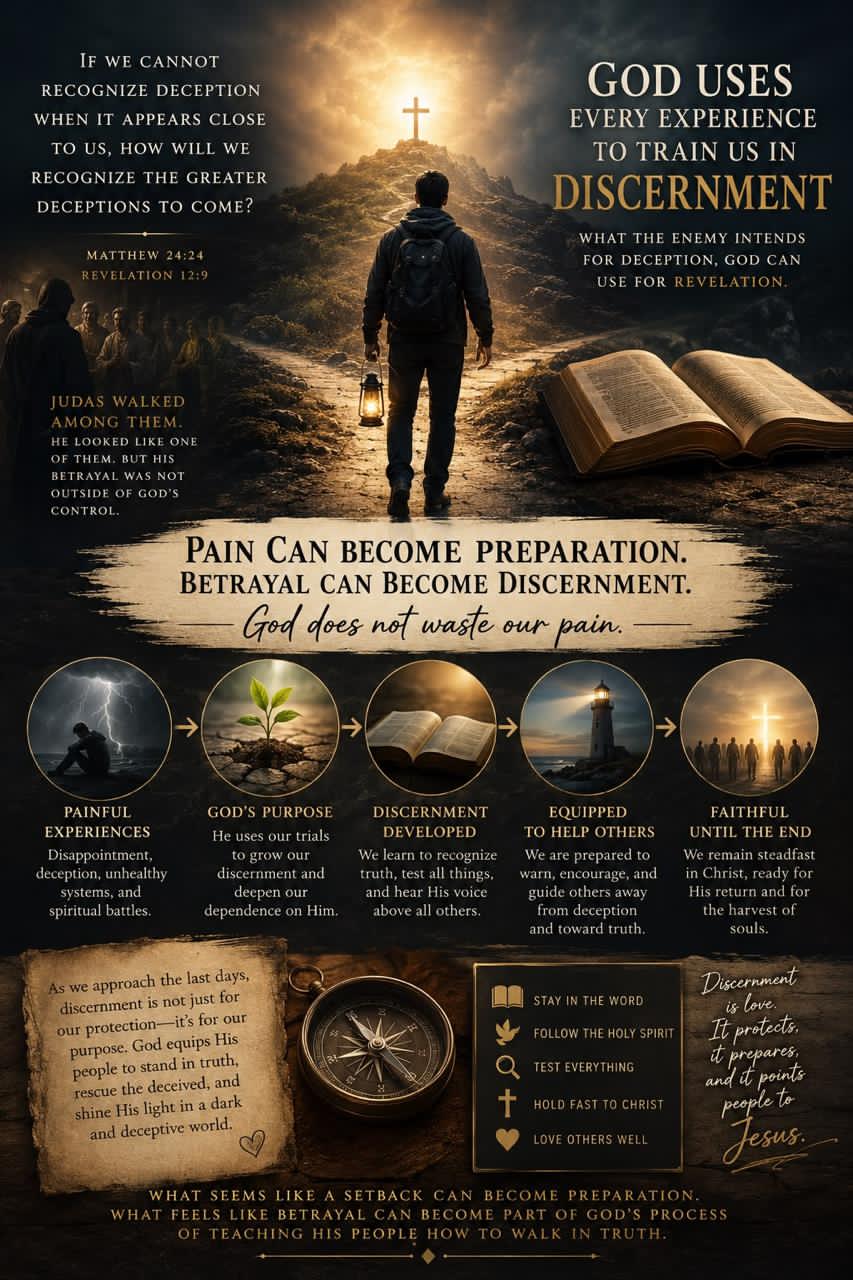
Perhaps some of the painful experiences we face today are not punishments, but training grounds for discernment.
Jesus knew that Judas would betray Him, yet He still allowed Judas to walk among the disciples. Judas’ betrayal was not outside of God’s control. God used even that act of evil to accomplish the greatest act of redemption the world has ever known.
What must have been confusing for the disciples is that the betrayal came from within their own group. Judas looked like one of them. He preached, served, traveled with Jesus, and witnessed the same miracles as everyone else. Yet Jesus allowed this deception to be exposed at the proper time.
In a similar way, Jesus warned that in the last days deception would arise from within religious circles and become so convincing that it could deceive “if possible, even the elect” (Matthew 24:24). Revelation describes Satan as the one who “leads the whole world astray” (Revelation 12:9), and repeatedly calls God’s people to patient endurance and discernment.
This raises an important question: If we cannot recognize deception when it appears close to us, among people we trust, within systems we love, or within our own religious traditions, how will we recognize the greater deceptions that Scripture says will come in the last days?
Perhaps some of the painful experiences God’s people walk through are not merely obstacles to overcome but opportunities to grow in discernment. Just as Judas’ betrayal ultimately served God’s redemptive purpose, God can use our encounters with false teachings, unhealthy systems, misplaced zeal, and spiritual manipulation to teach us to rely more deeply on Christ, the Holy Spirit, and the Scriptures.
What may feel like a curse in the moment can become a blessing if it opens our eyes. The lessons learned through disappointment, disillusionment, and even betrayal can equip us to recognize truth from error and prepare us for the greater deceptions Scripture warns about.
God does not waste our pain. He can use it to strengthen our faith, deepen our dependence on Him, and train us to discern His voice above all others. In that sense, what the enemy intends for deception, God can use for revelation. What seems like a setback can become preparation. And what feels like betrayal can become part of God’s process of teaching His people how to walk in truth.
As we approach the last days, this discernment is not meant only for our own protection. God equips His people so that they can help others recognize truth, avoid deception, and remain faithful to Christ. The lessons He teaches us through trials can become tools for ministry, enabling us to encourage, warn, and guide those who may be struggling to see clearly. In this way, our experiences become part of God’s preparation not only for our own perseverance but also for the rescue and strengthening of as many people as possible before Christ’s return.